In this guide
What the test is
The Croatian citizenship test is a short written questionnaire that checks your knowledge of Croatian culture and social order. Its official name is provjera poznavanja hrvatske kulture i društvenog uređenja. It is one of the conditions for becoming a Croatian citizen by naturalisation (prirođenje).
It is not a language exam and it is not a sit-down exam on a fixed date. You take it once, at the police station, as part of handing in your citizenship application.
The legal basis
The test is set out in the Pravilnik o načinu provjere poznavanja hrvatskog jezika i latiničnog pisma, hrvatske kulture i društvenog uređenja u postupcima stjecanja hrvatskog državljanstva — the regulation on how knowledge of the Croatian language and Latin script, Croatian culture and social order is checked in citizenship procedures. It was published in the official gazette, Narodne novine, issue 6/2021.
The 110 questions the test is drawn from are printed in the annex to that regulation, Prilog 1. They are public — but only the questions. No answers are published.
Who has to take it, and who is exempt
The test applies to foreigners applying for Croatian citizenship by naturalisation. The regular route requires, among other things, 8 years of continuous legal residence in Croatia and approved permanent residence (stalni boravak).
You do not have to take the test if:
- you are over 60, or
- you are an emigrant or a descendant of emigrants applying under Article 11 of the Citizenship Act.
Requirements can depend on your situation. The Ministry of the Interior explains the regular route on its page on regular naturalisation, and your police administration can confirm what applies to you.
How it works on the day
- You hand in your citizenship applicationat the police administration or police station (policijska uprava / policijska postaja).
- The official prepares your questionnaireby picking 15 questions at random from the 110 official ones.
- You fill it in on your own, in front of the officialwithout help. You have 60 minutes.
- You answer each question in one of two wayseither by circling one answer from a to d, or by writing the missing word or words in a blank.
- The official marks it on the spotand tells you immediately whether you passed. You need at least 10 correct answers out of 15.
- If you fail, you can see your marked paperyou may ask to look at it, but you may not take the questionnaire away.
The separate B1 Croatian language requirement
The civics test does not check your Croatian as such. Croatian at B1 level and knowledge of the Latin script are proven separately, with a certificate — for example from an exam at an authorised institution, a Croatian school certificate, or a B1 course certificate.
In practice the two go together: the citizenship test itself is written in Croatian, so the language you learn for B1 is the language you will read the questions in.
What the questions cover
The 110 questions range across state organisation, history, culture, customs, art, literature, sport, the economy, tourism and geography. To make them easier to learn, CivicLearn sorts them into six groups. This grouping is ours, not an official one, and the 15 questions on your paper are picked at random, not by topic.
- State and societyDržavno i društveno uređenje27 questions
- HistoryPovijest18 questions
- Geography and natureGeografija i priroda15 questions
- Heritage and customsKulturna baština i običaji18 questions
- Literature and artKnjiževnost i umjetnost20 questions
- Science, economy and sportZnanost, gospodarstvo i sport12 questions
See two real questions from each group, with translations and answers, on Croatian citizenship test questions by topic.
Why it is harder than it looks
Fifteen questions, an hour, and only ten right answers needed: on paper it sounds easy. For people who did not grow up in Croatia, four things make it harder.
The questions are only in Croatian
There is no English, Ukrainian or Russian version. The questions are often long, formal sentences with names of places, people and institutions you may never have met in everyday Croatian.
Some answers must be written, not chosen
Not every question has options. In the official list, 42 of the 110 questions have a blank where you write the answer yourself — in Croatian, with the name or term spelled out.
The official list has no answers
Prilog 1 gives the 110 questions and nothing else. Lists of answers that circulate online are made by other people, and they are not always right.
A few facts have changed since 2021
The questions were published in 2021, and some correct answers have moved on since. The clearest case is money: Croatia has used the euro since 1 January 2023, replacing the kuna, but older answer lists may still give the kuna. You need answers that have been checked against today’s facts.
How to prepare
- Learn the questions in Croatian. Use a translation to understand them, but practise recognising the Croatian wording, because that is all you will see.
- Practise writing the written-answer questions. Names such as people, places and works need to come to you without options to choose from.
- Use checked answers. Make sure your source reflects current facts, such as the euro.
- Do full timed runs. Fifteen random questions in 60 minutes, as on the day, and aim for comfortably more than 10.
- Sort out your B1 certificate separately. It is a different requirement, with its own exam or certificate.
Our recommendation: the CivicLearn course
We work with CivicLearn, which sells and runs this course. We recommend it because it solves the problems above.
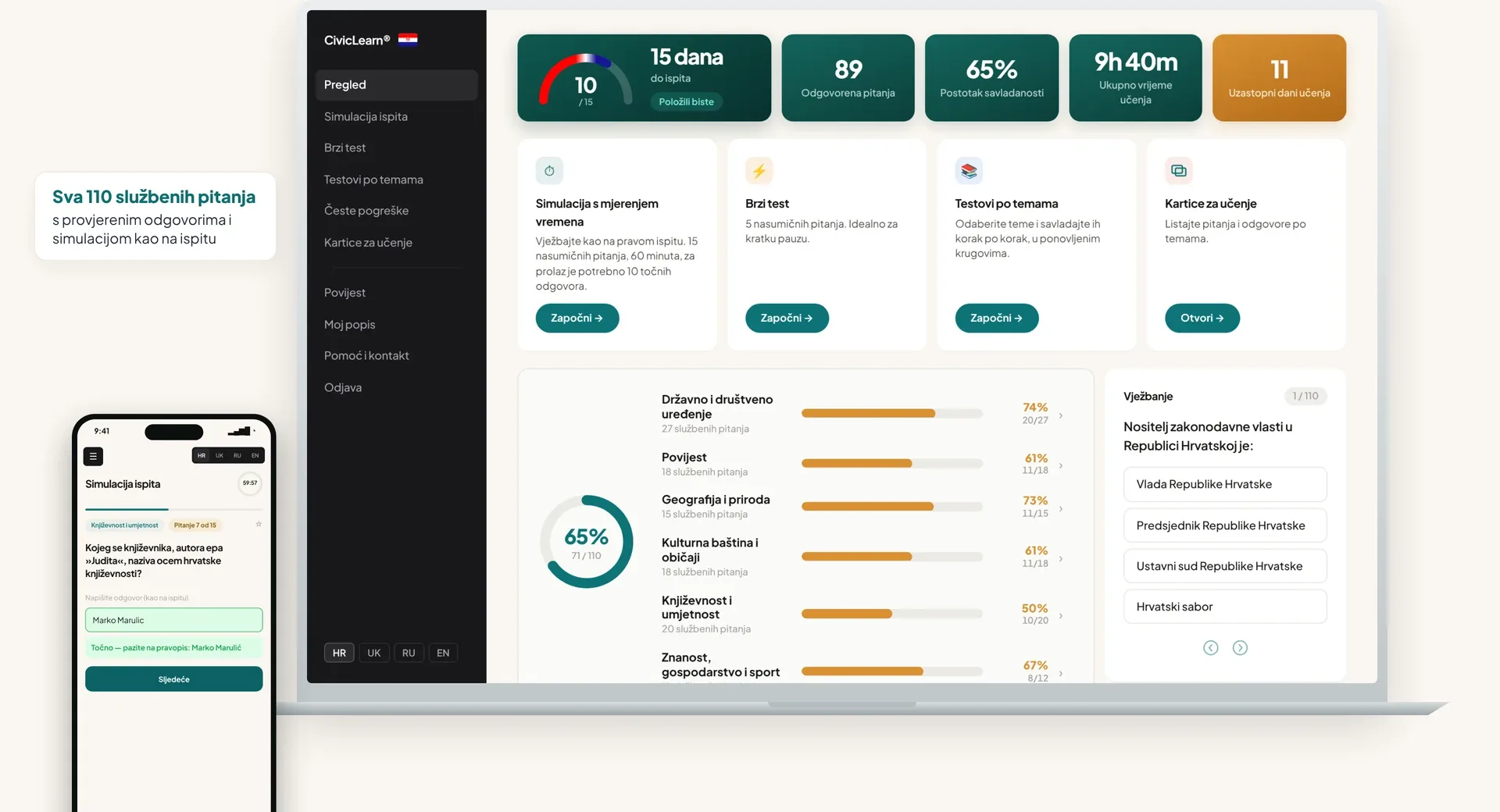
CivicLearn’s Croatian citizenship test course (Ispit za hrvatsko državljanstvo) covers the whole official list, in Croatian, with English alongside.
- All 110 official questions from Narodne novine 6/2021 (Prilog 1), with checked correct answers — the official list has none.
- Every question in Croatian, as in the test, with an English translation underneath.
- A short “Good to know” explanation for every question.
- A simulation like the real test: 15 random questions, 60 minutes, pass at 10. The 42 written-answer questions have to be typed, as on the paper, and are checked automatically — missing č, ć, š, ž, đ, capital letters and small typos are tolerated.
- Practice by topic in six groups, quick 5-question tests, flashcards, a list of saved questions and the common traps.
- Your results and progress per topic saved to your account; works on phone, tablet and computer.
Secure card payment via Stripe; access immediately after payment. The interface is in English, Croatian, Ukrainian and Russian. Already a customer? Log in.
Questions and answers
Is the Croatian citizenship test available in English?
No. The questionnaire is written in Croatian, and you fill it in on your own, without help. English translations are useful for learning, but on the day you will only see the Croatian text.
How many questions are there, and how many do I need to pass?
The official list has 110 questions. The official picks 15 of them at random for your questionnaire, and you pass with at least 10 correct answers out of 15. You have 60 minutes.
Where do I take the test?
At the police administration or police station (policijska uprava / policijska postaja), when you submit your application for Croatian citizenship. There is no separate exam date to book: you fill in the questionnaire there, in front of the official.
Are the answers to the 110 questions published?
No. The annex to the Pravilnik (Prilog 1) lists the questions only, without answers. You have to find and check the answers yourself — or use a course that has done it, like CivicLearn’s.
Who does not have to take the test?
Applicants over 60, and emigrants and their descendants applying under Article 11 of the Citizenship Act, are exempt. Check your own case with the police administration or the Ministry of the Interior.
Does the test cover the Croatian language requirement?
No. Croatian at B1 level and the Latin script are proven separately, with a certificate: an exam at an authorised institution, a Croatian school certificate or a B1 course certificate.
What happens if I do not pass?
The official marks your questionnaire on the spot and tells you the result straight away. If you fail, you may ask to see your marked questionnaire, but you may not take it away.
Is this an official website?
No. This is an independent guide. It is run by Testrada Pte Ltd, which works with CivicLearn, the company that sells the course we recommend. For official information, see the Ministry of the Interior (MUP) and Narodne novine.
How much does the CivicLearn course cost?
49 € once, with unlimited access. There is no subscription and no automatic renewal. Payment is by card through Stripe, and access starts immediately.
Sources
- Narodne novine 6/2021: Pravilnik o načinu provjere poznavanja hrvatskog jezika i latiničnog pisma, hrvatske kulture i društvenog uređenja u postupcima stjecanja hrvatskog državljanstva, with the 110 questions in Prilog 1.
- Ministry of the Interior (MUP): Koji je redovit način stjecanja hrvatskog državljanstva? (the regular way of acquiring Croatian citizenship).
This guide is for orientation and is not legal advice. Last reviewed October 2026.